Pay-Per-Mile EV Tax: How Much Will UK Drivers Actually Pay?
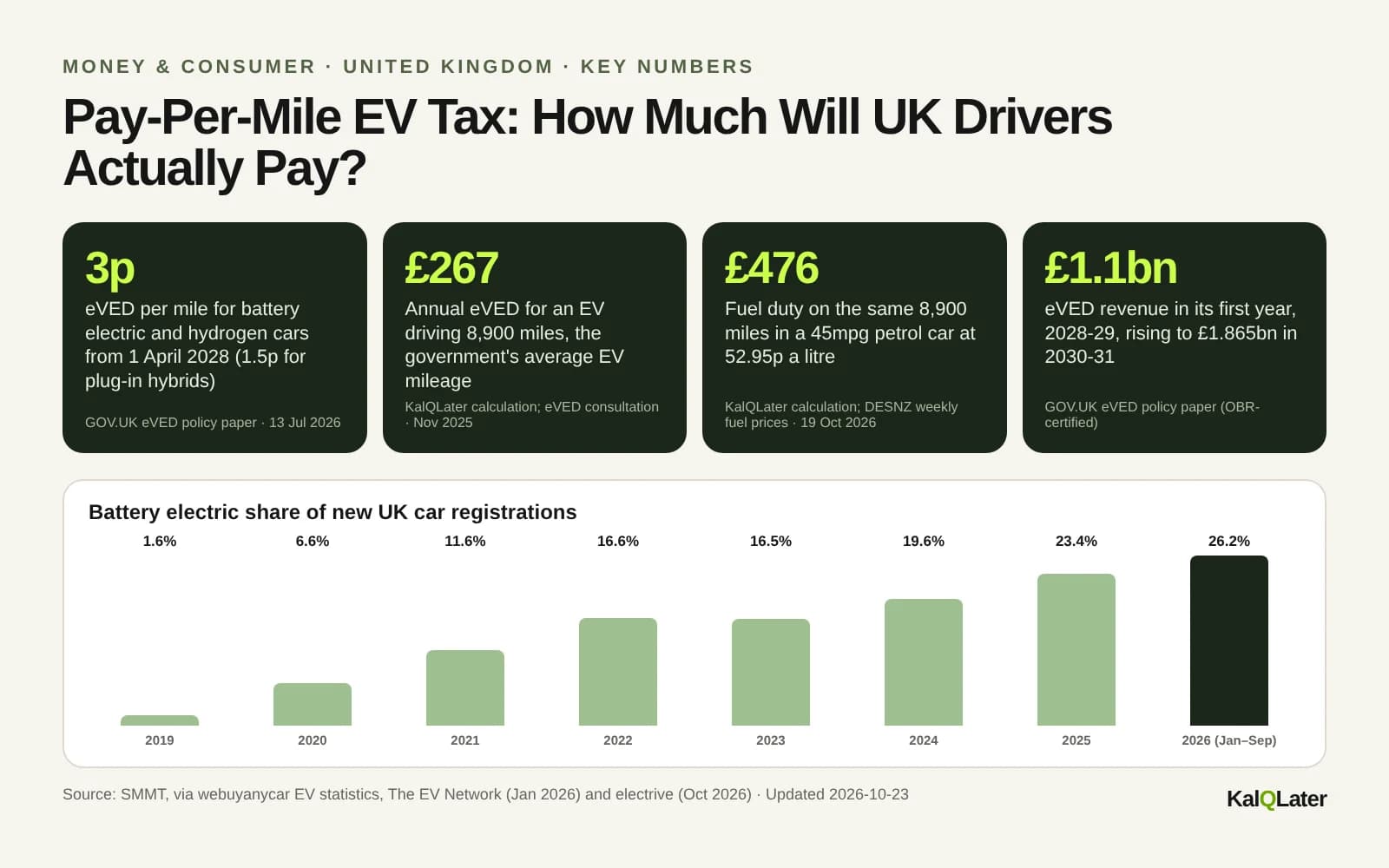
From 1 April 2028 UK electric car drivers will pay Electric Vehicle Excise Duty (eVED) of 3p per mile, and plug-in hybrid drivers 1.5p, so a typical EV doing 8,900 miles pays £267 a year. That is about 56% of the £476 in fuel duty a 45mpg petrol car pays over the same miles at today's 52.95p a litre. Charging at home, an EV's total energy-plus-tax bill stays well below petrol. Charging mainly on public rapid chargers, it does not.
The short answer: how much is the pay-per-mile EV tax?
eVED is set at 3p a mile for electric cars and 1.5p for plug-in hybrids from April 2028, which works out at £150 a year at 5,000 miles, £267 at 8,900 miles and £450 at 15,000 miles. It is paid through the existing DVLA vehicle tax system, on top of the standard £200 a year car tax.
The tax is confirmed. The government published its consultation response and a policy paper on 13 July 2026, keeping the rates announced in the November 2025 Budget. The policy paper says the change "will have effect from 1 April 2028".
Our headline finding: EV drivers will pay roughly half the per-mile tax that petrol drivers pay, which is exactly what the Treasury designed. The government says the 3p rate is "half of the equivalent rate of fuel duty". On our own maths, 3p is 56% of the 5.35p of fuel duty per mile a 45mpg petrol car pays today.
Whether the total cost of running an EV beats petrol depends far more on where you charge than on eVED. A home charger at the October 2026 price cap rate keeps an EV hundreds of pounds a year cheaper. Relying on public rapid chargers wipes out the saving even before eVED.
Pay-per-mile EV tax calculator
Enter your annual mileage and car type to see your eVED bill from April 2028, what a petrol car would pay in fuel duty over the same miles, and how total energy costs compare at home and public charging prices. Defaults use rates as of 23 October 2026.
Advanced: rates and prices
- Pay-per-mile tax a year (from April 2028)
- £267.00
- Per month
- £22.25
- Fuel duty a petrol car pays for the same miles
- £476.08
- eVED as share of that fuel duty
- 56.1%
- EV energy cost a year
- £669.28
- EV total (energy + eVED)
- £936.28
- Petrol car fuel cost a year
- £1,569.59
- EV cheaper by
- £633.31
- Break-even mpg (duty per mile = eVED)
- 80.2 mpg
Estimates. Rates as of 23 October 2026; eVED starts 1 April 2028 and rises with CPI from 2029-30. Standard VED applies to both EVs and petrol cars and is excluded.
How will the UK EV mileage tax work?
You will give an odometer reading and estimate your mileage each time you renew vehicle tax, pay 3p for each estimated mile, and settle up at the end of the year. Payment can be annual, six-monthly or monthly, and the MOT reading is used to check what you declare.
- Start date 1 April 2028, for all UK-registered electric and plug-in hybrid cars (GOV.UK policy paper).
- Rates 3p per mile for battery electric and hydrogen fuel cell cars; 1.5p per mile for plug-in hybrids and range-extender cars (consultation response).
- Uprating Rates rise with CPI inflation from 2029-30. The government's own worked example uses 2% CPI, which would make the rate 3.06p.
- Measuring mileage At each renewal the keeper submits an odometer reading and an estimate for the year ahead. DVLA reconciles this against the next reading. Where a car has an MOT, the verified MOT reading is used to check declarations. Cars under three years old (four in Northern Ireland) will not need separate mileage checks.
- Payment Annually, six-monthly or monthly, through the same DVLA channels as vehicle tax, including the Post Office. Monthly Direct Debit carries a 5% surcharge, the same as current vehicle tax.
- Top-ups and credits You can top up if you drive more than estimated. Unused miles carry forward as credit. Cash refunds are available for hardship (over £100, self-certified) and pro rata for stolen or written-off cars.
- Not in scope Electric vans, buses, coaches and HGVs are out of scope at launch, as are hearses, campervans and petrol cars converted to electric.
What will eVED cost at different mileages?
At 3p a mile, an electric car pays £150 a year at 5,000 miles, £267 at 8,900, £300 at 10,000 and £450 at 15,000. A plug-in hybrid pays exactly half. A 45mpg petrol car pays £267 to £802 in fuel duty over the same distances.
| Annual miles | EV eVED (3p) | EV monthly by Direct Debit (+5%) | PHEV eVED (1.5p) | Petrol fuel duty at 45mpg (52.95p/litre) |
|---|---|---|---|---|
| 5,000 | £150.00 | £13.12 | £75.00 | £267.46 |
| 8,000 | £240.00 | £21.00 | £120.00 | £427.94 |
| 8,900 (gov't average EV) | £267.00 | £23.36 | £133.50 | £476.08 |
| 10,000 | £300.00 | £26.25 | £150.00 | £534.92 |
| 15,000 | £450.00 | £39.37 | £225.00 | £802.38 |
The 8,900-mile row uses the eVED consultation's own figure: "The average EV driver drives around 8,900 miles per year." The 5,000-mile row matches the government's worked example of £150 a year, or £13.12 a month with the Direct Debit surcharge. The 8,000-mile row matches the ZEV mandate review's example of £240 a year.
The petrol column is fuel duty only, excluding the 20% VAT charged on top of duty at the pump. Including that VAT, the 8,900-mile petrol driver hands over £571 in duty-related tax. Fuel duty is also scheduled to rise, so the gap could widen by 2028 unless the Budget changes course.
Plug-in hybrids are a special case. They pay 1.5p a mile on every mile, electric or not, and they also pay fuel duty on the petrol they burn. The 1.5p rate assumes roughly equal electric and petrol use, an assumption Auto Express notes a Fraunhofer Institute study considered optimistic for real-world driving.
Will an EV still be cheaper to run than petrol after the mileage tax?
Yes, if you charge at home: at 8,900 miles an EV costs about £936 a year in electricity plus eVED, against £1,570 in petrol for a 45mpg car. On public rapid chargers at 79p per kWh the same EV costs £2,276, about £706 more than petrol.
Annual energy plus eVED at 8,900 miles, EV vs 45mpg petrol car (£)
Source: KalQLater calculation using Ofgem price cap Oct–Dec 2026, Zapmap Price Index Sep 2026, DESNZ weekly road fuel prices 19 Oct 2026View the data
| Label | Value |
|---|---|
| EV, home charging (26.32p/kWh) + eVED | £936 |
| Petrol car, 45mpg (174.57p/litre) | £1,570 |
| EV, public slow/fast (54p/kWh) + eVED | £1,640 |
| EV, public rapid (79p/kWh) + eVED | £2,276 |
| Annual miles | EV home (26.32p/kWh) + eVED | EV public rapid (79p/kWh) + eVED | Petrol 45mpg at 174.57p/litre |
|---|---|---|---|
| 5,000 | £526 | £1,279 | £882 |
| 8,900 | £936 | £2,276 | £1,570 |
| 10,000 | £1,052 | £2,557 | £1,764 |
| 15,000 | £1,578 | £3,836 | £2,645 |
The inputs: the Ofgem price cap electricity unit rate of 26.32p per kWh for 1 October to 31 December 2026 (with VAT on electricity removed until 31 March 2027), Zapmap's September 2026 averages of 54p per kWh for public slow and fast charging and 79p for rapid and ultra-rapid, and the government's weekly average petrol price of 174.57p a litre for the week of 19 October 2026.
Off-peak EV tariffs make the home case stronger. Zapmap quotes off-peak EV tariffs "around 8.9" per kWh (the page omits the unit; it is likely pence). At that rate, 8,900 miles of electricity would cost about £226 before eVED, though few drivers charge entirely off-peak.
Why does the Treasury need a pay-per-mile tax?
Fuel duty raised £24.6 billion in 2025-26, but the OBR expects it to fall to around half that (about £12 billion a year) by the 2030s as drivers switch to electric. eVED is designed to plug part of that gap, raising £1.1 billion in 2028-29 and £1.865 billion by 2030-31.
UK fuel duty (hydrocarbon oil) receipts, £bn
Source: HMRC annual tax receipts bulletin (Aug 2026); 2024-25 from HM Treasury eVED consultation (Nov 2025)View the data
| Label | Value |
|---|---|
| 2006-07 | £23.6bn |
| 2018-19 | £28.1bn |
| 2019-20 | £27.5bn |
| 2020-21 | £21.2bn |
| 2021-22 | £26.0bn |
| 2022-23 | £25.1bn |
| 2024-25 | £24.4bn |
| 2025-26 | £24.6bn |
In cash terms fuel duty has barely moved in 20 years: £23.6 billion in 2006-07 and £24.6 billion in 2025-26, according to HMRC. Adjusted for the size of the economy it has halved, from 1.6% of GDP to 0.8%. HMRC attributes recent falls mainly to lower diesel receipts as drivers move "towards alternative fueled vehicles, including electric and hybrid electric vehicles".
The rate itself has been frozen at 52.95p a litre, including a temporary 5p cut, since 2022. The government's weekly price data still shows 52.95p for the week of 19 October 2026, and the cut now runs to 31 December 2026. The OBR warns that if rates simply stayed frozen, receipts from 2027-28 to 2030-31 would average £3.6 billion a year less than its forecast.
| Financial year | Impact |
|---|---|
| 2026-27 | -10 |
| 2027-28 | -15 |
| 2028-29 | +1,100 |
| 2029-30 | +1,435 |
| 2030-31 | +1,865 |
The early negative years are set-up costs. The policy paper estimates about 5.6 million vehicles will be affected in 2028-29. The OBR's November 2025 outlook says the charge will offset "around one-quarter" of the 0.6% of GDP in revenue set to be lost from fuel duty by 2050. The government says around 80% of eVED revenue in the first three years will go back into its EV support package, worth over £7.5 billion over the next decade.
Will the mileage tax slow EV sales?
The OBR estimates around 440,000 fewer electric car sales over its forecast period because of eVED, of which 320,000 are offset by other Budget measures such as the extra £1.3 billion for the Electric Car Grant. So far sales are still rising: battery EVs took 26.2% of new cars in the first nine months of 2026.
Battery electric share of new UK car registrations
Source: SMMT, via webuyanycar EV statistics, The EV Network (Jan 2026) and electrive (Oct 2026)View the data
| Label | Value |
|---|---|
| 2019 | 1.6% |
| 2020 | 6.6% |
| 2021 | 11.6% |
| 2022 | 16.6% |
| 2023 | 16.5% |
| 2024 | 19.6% |
| 2025 | 23.4% |
| 2026 (Jan–Sep) | 26.2% |
The OBR's November 2025 outlook said the charge "is likely to reduce demand for electric cars as it increases their lifetime cost". The consultation response puts the effect as "around 2% dampening" on new EV sales, and says the wider package offsets most of it. The OBR still forecasts EV sales rising from nearly 0.5 million in 2025-26 to around 1.6 million in 2030-31.
The real pressure point is the Zero Emission Vehicle mandate. Its legislated targets are 28% for 2025, 33% for 2026 and 52% for 2028, the year eVED starts. The SMMT says hitting 33% in 2026 would need about 265,000 extra battery EV registrations in the final quarter alone. SMMT chief executive Mike Hawes has called eVED "the wrong measure at the wrong time".
ZEV mandate: required zero-emission share of new cars
Source: DfT Zero Emission Vehicle Mandate Review consultation, Aug 2026 (legislated targets)View the data
| Label | Value |
|---|---|
| 2024 | 22% |
| 2025 | 28% |
| 2026 | 33% |
| 2027 | 38% |
| 2028 | 52% |
| 2029 | 66% |
| 2030 | 80% |
The government is already consulting on easing that path. Its ZEV mandate review, which closes at 11:59pm on 23 October 2026, offers options including a 70% target for 2030 instead of 80%, while keeping the 2030 petrol and diesel phase-out and the 2035 zero-emission goal.
What other taxes do electric car drivers already pay?
Since April 2025 electric cars pay vehicle tax like everyone else: £10 in the first year, then £200 a year, plus a £440 Expensive Car Supplement for EVs listed above £50,000. eVED from 2028 comes on top of this, not instead of it.
- Vehicle Excise Duty (VED) The GOV.UK rate tables show a standard rate of £200 for a 12-month payment, or £210 by monthly Direct Debit, for cars registered since April 2017. Zero-emission cars pay £10 in their first year.
- Expensive Car Supplement £440 a year for five years from the second tax payment. The threshold is £40,000 for petrol and diesel cars but £50,000 for electric cars, a change announced at Budget 2025.
- Company car tax Carwow reports the benefit-in-kind rate on electric company cars rises from 4% to 5% next year, then 7% and 9% by 2029, versus typically 25–37% for petrol and diesel.
- VAT on charging Home electricity carries no VAT from 1 October 2026 to 31 March 2027. Public charging is still charged at 20% VAT; a cut is speculated for the Budget but not confirmed.
So an EV doing 8,900 miles from April 2028 would face £200 of standard VED plus £267 of eVED, or £467 a year, before any Expensive Car Supplement. A petrol car pays the same £200 VED plus around £476 in fuel duty on those miles (plus VAT on the duty).
Are plug-in hybrid drivers hit twice?
Yes, in effect: plug-in hybrids pay 1.5p a mile on all miles and fuel duty on every litre of petrol. At 15,000 miles with half on electric, that is £225 of eVED plus about £401 of fuel duty, more tax than a pure EV pays at 3p.
The government rejected charging PHEVs differently for electric and petrol miles as impractical, according to Auto Express's report on the consultation response. Instead the 1.5p flat rate is meant to approximate half-electric use.
Our worked example, 15,000 miles split evenly at 45mpg in petrol mode and 3.5 miles per kWh on home electricity: £564 of electricity, £1,323 of petrol (of which £401 is fuel duty) and £225 of eVED, a total of £2,112. A pure EV on home charging over the same miles costs £1,578 including eVED. PHEV drivers who rarely plug in pay the 1.5p for little benefit.
PHEVs are growing fast regardless: they took 17% of new cars in September 2026, with registrations up 55.7% year on year, according to preliminary SMMT figures reported by electrive.
What should EV drivers do before April 2028?
Work out your real annual mileage now, budget about 3p a mile (£25 a month per 10,000 miles), and secure home or cheap off-peak charging if you can. Charging location will move your costs far more than eVED.
- 1Check your mileage
Look up your last two MOT odometer readings on GOV.UK or your car's trip history. Divide the difference by the years between them.
- 2Budget the eVED
Multiply annual miles by £0.03 (EV) or £0.015 (PHEV). If you plan to pay monthly by Direct Debit, add 5%.
- 3Estimate honestly
Underestimates must be topped up; overestimates carry forward as credit, with cash refunds only in limited cases. A realistic estimate avoids both.
- 4Fix your charging cost
The difference between 26p and 79p per kWh is about £1,340 a year at 8,900 miles, five times the eVED bill. An off-peak home tariff is the single biggest saving.
- 5Watch 28 October
Check the Budget for fuel duty, public charging VAT and any eVED detail, then rerun the calculator above.
- 6If buying used
From 2028, sellers must settle outstanding eVED before a sale, and buyers can check paid mileage on the DVLA website, according to the RAC.
Pay-per-mile EV tax: claims vs evidence
“EV drivers will pay more tax than petrol drivers”
At 3p a mile eVED is about 56% of fuel duty for a 45mpg petrol car (5.35p a mile). Only a petrol car doing 80mpg would pay as little. Both pay the same £200 VED.
False“The government will track EVs with GPS”
Standard reporting is an odometer reading at renewal checked against the MOT. A connected-car route is opt-in only, and the RAC reports location tracking would not be required.
False“eVED will kill EV demand”
OBR estimates 440,000 fewer EV sales, 320,000 offset by other Budget measures, and still forecasts sales rising to about 1.6 million in 2030-31. BEV share hit 26.2% in Jan–Sep 2026.
Misleading“EVs will still be cheaper to run than petrol cars”
True for home charging (£936 vs £1,570 a year at 8,900 miles), but false for drivers who rely on rapid public chargers (£2,276).
Partly true“eVED replaces lost fuel duty”
OBR says it offsets around one-quarter of the 0.6% of GDP fuel duty revenue lost by 2050. It raises £1.865bn in 2030-31 against a £24.6bn fuel duty base.
Partly true“The 3p rate will stay at 3p”
Rates rise with CPI from 2029-30; the government's own example uses 3.06p at 2% CPI.
FalseFrequently asked questions
How much is the pay-per-mile tax for electric cars?
Electric Vehicle Excise Duty will be 3p per mile for battery electric and hydrogen cars and 1.5p per mile for plug-in hybrids and range extenders, from 1 April 2028. An EV doing 8,900 miles a year, the government's average, will pay £267. Rates rise with CPI inflation from 2029-30.
When does the EV mileage tax start in the UK?
eVED starts on 1 April 2028. It was announced in the November 2025 Budget, consulted on from 26 November 2025 to 18 March 2026, and confirmed in the government's consultation response and policy paper published on 13 July 2026.
Do EV drivers still pay normal road tax as well?
Yes. eVED is charged on top of vehicle tax. Since April 2025 electric cars pay £10 in the first year and then the £200 standard rate, plus £440 a year for five years if the list price is over £50,000.
How will the government know how many miles I drive?
You give an odometer reading and estimate your mileage for the year each time you renew vehicle tax. DVLA reconciles it against your next reading, and MOT readings are used as checks. Cars under three years old won't need extra mileage checks. Reporting via your car's connectivity will be optional.
Can I pay the EV mileage tax monthly?
Yes. You can pay annually, six-monthly or monthly through DVLA, like vehicle tax. Monthly Direct Debit adds 5%, so 5,000 miles costs £150 a year or £13.12 a month in the government's example.
Is the pay-per-mile tax cheaper than fuel duty?
Yes, for almost every driver. Fuel duty is 52.95p a litre, about 5.35p a mile in a 45mpg petrol car, so 8,900 miles costs £476 in duty. eVED on the same miles is £267. A petrol car would need about 80mpg to pay as little.
Do plug-in hybrids pay the mileage tax?
Yes, at 1.5p per mile on all miles, including those driven on petrol, and they still pay fuel duty on the petrol they buy. At 10,000 miles that is £150 a year in eVED alone.
Are miles driven abroad charged?
Under the standard route, yes: eVED is based on total odometer miles, and the government estimates about 2% of car mileage is driven abroad. Auto Express reports that drivers using the optional connected-car route would only be charged for UK miles.
How we built this analysis
- eVED: annual miles × 3p (BEV) or 1.5p (PHEV), the 2028-29 rates in the GOV.UK policy paper. Monthly Direct Debit = annual ÷ 12 × 1.05 (5% surcharge, consultation response). Example: 8,900 × £0.03 = £267.00; ÷ 12 = £22.25; × 1.05 = £23.36.
- Petrol fuel duty per mile: 4.54609 litres per gallon ÷ 45mpg = 0.10102 litres a mile × 52.95p = 5.349p a mile. At 8,900 miles: £476.08. VAT on duty (20%) excluded from the headline and shown separately (£571.30 including it). Break-even mpg = 4.54609 × 52.95 ÷ 3 = 80.2.
- EV energy cost: miles ÷ 3.5 miles per kWh × price per kWh. Home: 26.32p (Ofgem cap, Oct–Dec 2026, Direct Debit). Public: 54p slow/fast and 79p rapid (Zapmap Price Index, Sep 2026). 8,900 miles at home = 2,542.9 kWh × 26.32p = £669.28; plus eVED = £936.28.
- Petrol fuel cost: miles × 0.10102 litres × 174.57p (DESNZ weekly UK average unleaded, week of 19 October 2026, which includes duty and VAT). 8,900 miles = £1,569.59.
- PHEV example: 15,000 miles, 50% electric at 3.5 miles/kWh and 26.32p, 50% petrol at 45mpg and 174.57p, plus 1.5p eVED on all miles: £564.00 + £1,322.68 + £225.00 = £2,111.68.
- Average mileage: 8,900 miles is the eVED consultation's figure for the average EV driver (footnote 7, source not named). 5,000, 10,000 and 15,000 are illustrative.
Limitations
This analysis uses late-2026 prices for electricity, public charging and petrol; 2028 prices could be very different, and fuel duty is scheduled to rise after 31 December 2026 subject to the 28 October 2026 Budget. eVED rates will rise with CPI from 2029-30. Real EV efficiency varies from roughly 2.5 to 4.5 miles per kWh by car and season. The 8,900-mile average comes from the government consultation, which does not cite its source; we could not open DfT's per-car mileage table (NTS0901). The OBR sales effect is a forecast, not an outcome. This is general information, not financial or tax advice.
Spotted an error? See our corrections policy. Read how we work in our methodology and editorial standards.
Sources
- HM Treasury / HMRC (GOV.UK)Electric Vehicle Excise Duty (eVED) policy paperRates, 1 April 2028 start, OBR-certified Exchequer impact, 5.6m vehicles; 13 Jul 2026
- HM Treasury (GOV.UK)The introduction of Electric Vehicle Excise Duty (eVED): Consultation ResponseMileage reporting, payment options, 5% surcharge, worked examples, 2% sales dampening; July 2026
- HM Treasury (GOV.UK)Consultation on the Introduction of Electric Vehicle Excise Duty (eVED)8,900-mile average EV, ~6p/mile fuel duty, £480 average fuel duty, £24.4bn 2024-25; Nov 2025
- Office for Budget ResponsibilityEconomic and fiscal outlook, November 2025440,000 fewer EV sales (320,000 offset); one-quarter of lost fuel duty offset by 2050 (copy of OBR PDF)
- Office for Budget ResponsibilityFuel duties: tax by tax52.95p rate, staged increases, £3.6bn a year risk if frozen
- HMRCHMRC tax receipts and National Insurance contributions for the UK (annual bulletin)Fuel duty receipts 2006-07 to 2025-26, share of GDP; Aug 2026
- Department for Energy Security and Net ZeroWeekly road fuel pricesUnleaded 174.57p/litre and duty 52.95p, week of 19 Oct 2026
- DVLA (GOV.UK)Vehicle tax rate tables£200 standard rate, £10 first year for zero emission, £440 supplement, £50,000 EV threshold
- OfgemChanges to energy price cap between 1 October and 31 December 2026Electricity 26.32p/kWh, VAT removed to 31 Mar 2027
- Department for TransportZero Emission Vehicle Mandate Review consultationMandate targets 2024–2030, Option 1, £240 at 8,000 miles; Aug 2026
- ZapmapZapmap Price IndexPublic charging 54p and 79p per kWh, Sep 2026
- electriveUK posts strongest-ever month for BEV registrations in SeptemberSMMT: 26.2% BEV share Jan–Sep 2026, PHEV 17% in September
- webuyanycar / SMMTElectric car market statisticsSMMT annual BEV shares 2019–2024
- RACEV drivers set for pay-per-mile road taxScheme mechanics, used-car rules; 14 Jul 2026
- Auto Express / CarwoweVED details revealed; Will the Autumn Budget 2026 make driving more expensive?Opt-in telematics (Auto Express); Budget expectations and company car tax (Carwow, 5 Oct 2026)