Will the Bank of Canada Raise Rates on October 28, and What Happens at Your Mortgage Renewal?
Nobody knows yet, but as of 21 October 2026 markets put the odds of a quarter-point hike to 2.50% on October 28 at about 87% (Bloomberg overnight swaps data). The policy rate has been 2.25% since October 2025. For mortgage holders the bigger shock is already here: a borrower renewing a late-2021 five-year fixed at today's best 4.34% rate faces a monthly payment roughly 22% higher, hike or no hike.

Will the Bank of Canada raise rates on October 28?
A hike to 2.50% is now the market's base case, but it is not certain. Swaps data cited by Bloomberg priced roughly 87% odds on 20–21 October 2026, up from about 25% on 13 October. Scotiabank, BMO, RBC Dominion Securities and Desjardins now forecast a quarter-point move. TD, CIBC and Dominion Lending Centres had argued for a hold as recently as 19 October.
This is a preview, written on 23 October 2026, five days before the decision. The Bank of Canada will publish its rate announcement at 9:45 a.m. ET on Wednesday, 28 October 2026, together with its quarterly Monetary Policy Report (MPR), which contains the Bank's new forecasts for inflation and growth.
The policy rate has been 2.25% since a quarter-point cut on 29 October 2025. The Bank has held at every announcement since, most recently on 2 September 2026. A hike would be the first increase in more than three years, since the rate reached 5.00% in July 2023.
What changed in October was not the data so much as the Governor's tone. Tiff Macklem said in Bangkok that the Bank's inflation outlook would be 'quite a bit higher' than its July forecast, and several bank economists switched their calls within days. Markets moved from pricing a likely hold to a likely hike in about a week.
Not financial advice. Rate odds change daily; check the Bank of Canada's announcement on 28 October before making decisions.
Canadian mortgage renewal calculator
Enter your remaining balance, your current rate and the rate you are being offered at renewal. The calculator uses Canadian semi-annual compounding for fixed-rate mortgages and shows your old and new monthly payment, the difference per month and per year, and what happens if the renewal rate moves 0.25 percentage points either way. Defaults: a 2.12% late-2021 five-year fixed renewing at 4.34%, the lowest insured five-year fixed listed by Ratehub.ca on 23 October 2026.
- Monthly payment at current rate
- $2,555.71
- Monthly payment at renewal
- $3,109.86
- Monthly difference
- +$554.15 (21.7%)
- Annual difference
- +$6,649.80
- If renewal rate is +0.25 pp
- $3,175.87
- If renewal rate is −0.25 pp
- $3,044.56
Estimates only, assuming on-schedule monthly payments and no prepayments. Your lender's offer, insured/uninsured status and fees will change the result. Not financial advice. Rates as of 23 October 2026.
What are markets pricing for the October 28 rate announcement?
Markets swung from about 25% hike odds on 13 October to about 87% by 20–21 October 2026. The swing followed September's weaker-than-expected jobs report, then Governor Macklem's comments on 17 October and the 19 October CPI release. These are market-implied estimates from different data providers, not forecasts by the Bank.
Market-implied odds of an October 28 hike, October 2026 (%)
Source: LSEG via Reuters/Wealth Professional (Oct 9, 13); Commerzbank via FXStreet (before Oct 19); Bloomberg via Nyhetsbyrån Direkt and World Today News (Oct 19–21)View the data
| Label | Value |
|---|---|
| Oct 9 (pre-jobs) | 40% |
| Oct 13 | 25% |
| Before Oct 19 | 36% |
| Oct 19 a.m. | 70% |
| Oct 20–21 | 87% |
The low point came after Statistics Canada reported on 9 October that the economy lost 68,000 jobs in September and unemployment rose to 6.5%. LSEG data showed odds of an October hike dropping from roughly 40% to about 25%, and five economists surveyed by Canadian Mortgage Professional expected a hold.
The rebound came from the Governor. Commerzbank noted odds jumping from 36% to more than 75% on the morning of Monday 19 October, after Macklem's weekend remarks at the IMF and World Bank meetings. Bloomberg data reported by Nyhetsbyrån Direkt put the probability at 87% that evening, and Global News reported the same 87% on 21 October.
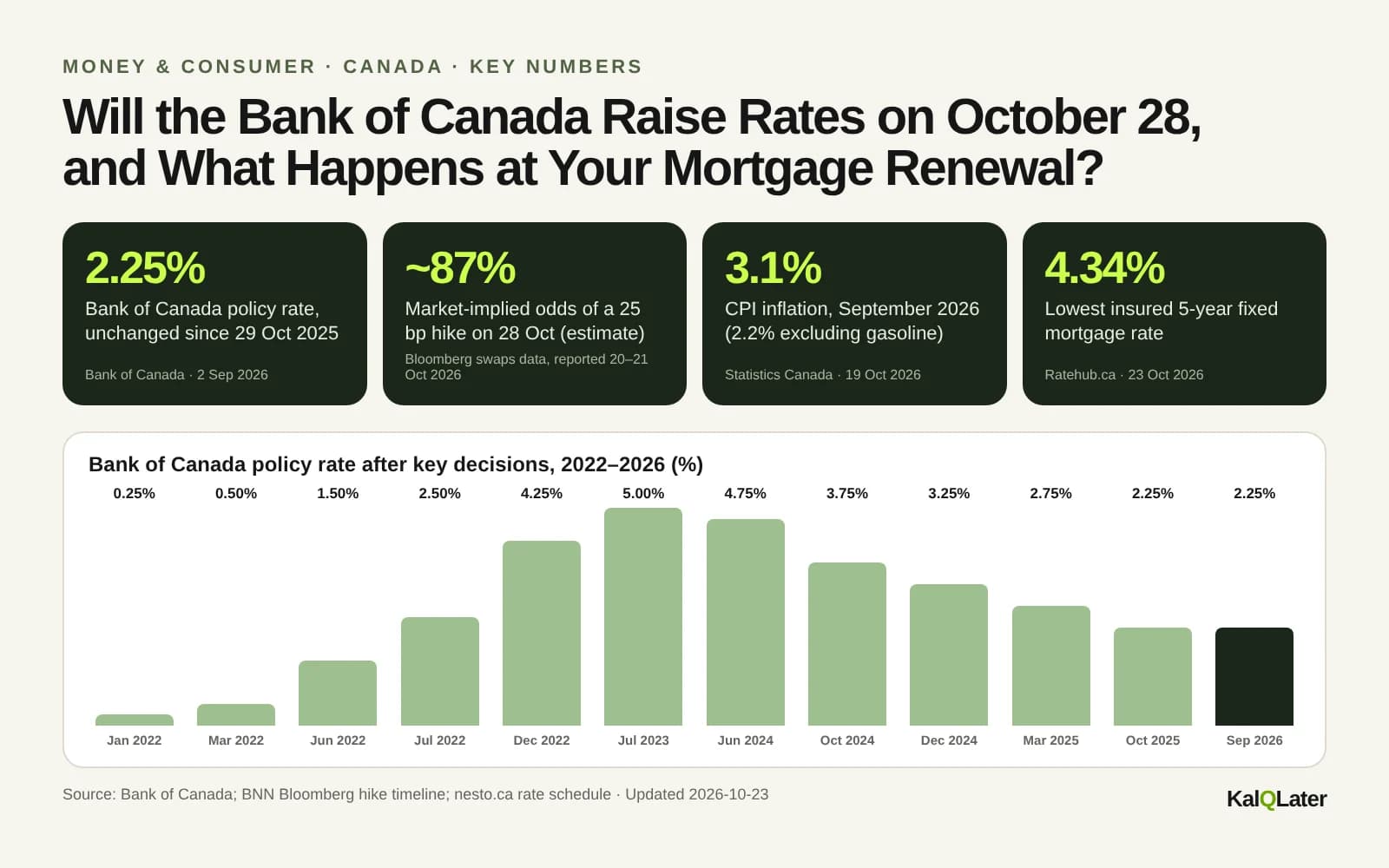
How did the Bank of Canada policy rate get to 2.25%?
The policy rate climbed from 0.25% in early 2022 to 5.00% in July 2023, then was cut nine times to 2.25% by October 2025. It has been held there through seven consecutive announcements. The prime rate at the big banks moved in step, from 2.45% at the end of 2021 to a 7.20% peak and 4.45% today.
Bank of Canada policy rate after key decisions, 2022–2026 (%)
Source: Bank of Canada; BNN Bloomberg hike timeline; nesto.ca rate scheduleView the data
| Label | Value |
|---|---|
| Jan 2022 | 0.25% |
| Mar 2022 | 0.50% |
| Jun 2022 | 1.50% |
| Jul 2022 | 2.50% |
| Dec 2022 | 4.25% |
| Jul 2023 | 5.00% |
| Jun 2024 | 4.75% |
| Oct 2024 | 3.75% |
| Dec 2024 | 3.25% |
| Mar 2025 | 2.75% |
| Oct 2025 | 2.25% |
| Sep 2026 | 2.25% |
The Bank raised rates ten times in 16 months during the last tightening cycle, including a full-point jump on 13 July 2022. That speed is why five-year fixed borrowers from 2020 and 2021, who locked in before the first hike, are now the group facing the biggest jump at renewal.
Prime rate at year end, 2021–2026 (%)
Source: Bank of Canada, prime rate series V80691311 (weekly)View the data
| Label | Value |
|---|---|
| 2021 | 2.45% |
| 2022 | 6.45% |
| 2023 | 7.20% |
| 2024 | 5.45% |
| 2025 | 4.45% |
| Oct 2026 | 4.45% |
Canadian Mortgage Trends reported that the prime rate was expected to stay at 4.45% after the September hold. A hike on Wednesday would very likely change that within a day, which is what variable-rate borrowers should be watching.
Hike, hold or cut: what are the arguments?
The case for a hike rests on inflation risk: CPI has been at or above 3% for three months, and business and consumer inflation expectations have risen. The case for a hold rests on weak jobs data and soft core inflation. No forecaster in our sources is calling for a cut.
- CPI rose to 3.1% in September, the top of the Bank's 1–3% target range, and has been at or above 3% for three straight months.
- Macklem said the new inflation outlook will be 'quite a bit higher' than in July and, in August, that 'there could well be a need to increase the policy rate'.
- Consumer five-year inflation expectations jumped to 3.91% in Q3 from 3.39% (Bank of Canada survey); 41% of firms expect inflation above 3% over two years.
- Q2 GDP grew 3.3%, and firms planning for a recession fell from 17% to 6%.
- Scotiabank calls it 'insurance' and notes that with a hike largely priced in, not delivering would loosen financial conditions.
- Canada lost 68,000 jobs in September after 42,000 in August; unemployment is 6.5%.
- Inflation excluding gasoline was 2.2% in September; CPI-trim was 1.8% and CPI-median 1.9%.
- Gasoline prices were up 27.8% from a year earlier, an energy shock the Bank has said it can 'look through' while it stays contained.
- Home sales and prices are falling, and fixed mortgage rates have already risen with bond yields.
- New US tariffs make growth 'more uncertain', in the Bank's own words.
- Rising unemployment and a shrinking public sector would normally argue for easing.
- But with inflation above 3% and the Bank warning of upside risks, none of the economists or markets cited here expect a cut in October.
Economists remain split on timing. Desjardins' Randall Bartlett switched to an October hike and expects another in January. Capital Economics sees one hike to 2.75%, the midpoint of the Bank's 2.25%–3.25% estimate of neutral, then a stop. RBC Economics, in its 16 October housing report, expected the overnight rate to rise by a total of one percentage point in 2027.
What do inflation and jobs data say before the decision?
Headline inflation is 3.1%, but almost all of the overshoot is gasoline: excluding it, CPI rose 2.2% in September. The job market is weakening, with 110,000 jobs lost across August and September. That mix is why the decision is close.
| Indicator | Latest | Previous | Source |
|---|---|---|---|
| CPI, 12-month change | 3.1% (Sep) | 3.0% (Aug) | Statistics Canada, 19 Oct |
| CPI excluding gasoline | 2.2% (Sep) | 2.4% (Aug) | Statistics Canada |
| CPI-trim / CPI-median | 1.8% / 1.9% | 1.9% / 2.0% | Statistics Canada via investingLive |
| Gasoline prices | +27.8% | +22.8% | Statistics Canada |
| Shelter | +1.8% | +1.5% | Statistics Canada |
| Mortgage interest cost | −0.2% | −0.2% | Statistics Canada |
| Employment change | −68,000 (Sep) | −42,000 (Aug) | Statistics Canada LFS, 9 Oct |
| Unemployment rate | 6.5% | 6.4% | Statistics Canada LFS |
| Real GDP growth, Q2 | 3.3% (annualized) | very weak Q1 | Bank of Canada, 2 Sep |
| Consumer 5-year inflation expectations | 3.91% (Q3) | 3.39% (Q2) | Bank of Canada CSCE via investingLive |
The mortgage interest cost index tells its own story. It peaked at 31% year-on-year in August 2023, according to TD Economics, and is now slightly negative. Rate cuts in 2024 and 2025 have flowed through to borrowers, which is part of why shelter inflation is only 1.8%.
For the jobs picture in detail, see our analysis of Canada's September job losses: the losses were concentrated in the public sector, and private employment was little changed.
What happens at your mortgage renewal in 2026?
A borrower who took a $500,000 five-year fixed at 2.12% in late 2021 would see the monthly payment rise from $2,146 to $2,612, up $465 or 21.7%, renewing at 4.34%. At the best big-bank rate of 4.84%, the increase is $577 a month, or 26.9%.
| Original mortgage | Balance at renewal | Old monthly payment | New at 4.34% | Change | New at 4.84% | Change |
|---|---|---|---|---|---|---|
| $400,000 | $335,925 | $1,717 | $2,089 | +$372 (+21.7%) | $2,179 | +$461 (+26.9%) |
| $500,000 | $419,907 | $2,146 | $2,612 | +$465 (+21.7%) | $2,723 | +$577 (+26.9%) |
| $600,000 | $503,888 | $2,576 | $3,134 | +$558 (+21.7%) | $3,268 | +$692 (+26.9%) |
Because the rate gap is the same, the percentage jump is identical at every loan size: about 22% at the best insured rate. Uninsured borrowers (20% or more down) are often quoted higher rates than insured ones, so the 4.84% column may be closer to what many renewers see from their own bank.
Would a hike on Wednesday change this table? Not directly. If the October 28 move pushes five-year fixed rates up another 0.25 points to 4.59%, the $500,000 example payment rises to $2,667, about $55 more than at 4.34%. If rates drift down 0.25 points to 4.09%, it falls to $2,557. Use the calculator above with your own balance.
How many Canadians face a mortgage payment shock?
About 12.4% of mortgage accounts, mostly five-year fixed loans from the pandemic, renew between mid-2026 and mid-2027 with an average payment increase of 15.2%, according to the Bank of Canada's May 2026 Financial Stability Report. Most borrowers on variable or shorter terms face little change.
| Mortgage type | Renewing | Share of mortgage accounts | Average payment change |
|---|---|---|---|
| Fixed payments, 5-year term or longer | 2026 H2 – 2027 H1 | 12.4% | +15.2% |
| Fixed payments, 5-year term or longer | 2027 H2 | 4.1% | +5.8% |
| Shorter fixed terms or variable payments | 2026 H2 – 2027 H1 | 14.4% | −0.04% |
| Shorter fixed terms or variable payments | 2027 H2 | 10.2% | +1.2% |
The Bank's estimates use market rate expectations as of 19 May 2026, before the latest jump in bond yields, so the real increases may be somewhat larger. Our 21.7% example is higher than the Bank's 15.2% average because it assumes a borrower who locked in near the very bottom of the market.
The Bank also estimated in its report that nearly 10% of Toronto-area borrowers renewing in 2027 might be unable to refinance, as TD Economics summarized. TD stressed that this is about refinancing ability after price declines, not the ability to renew with the existing lender.
An earlier Bank of Canada staff note (July 2025) found about 60% of all outstanding mortgages were due to renew in 2025 or 2026, and that roughly 10% of variable-rate, fixed-payment borrowers renewing in 2026 could see payments rise by more than 40%.
Fixed vs variable mortgage in 2026: which is better before a hike?
Today the best variable rate (3.43%) is about 0.9 points below the best five-year fixed (4.34%), per Ratehub.ca on 23 October 2026. Markets expect several hikes, so that gap could shrink. A 0.25-point hike would add about $67 a month to a $500,000 variable mortgage over 25 years.
Five-year Government of Canada benchmark bond yield, Sep 25 – Oct 22, 2026 (%)
Source: Bank of Canada, benchmark bond yield series BD.CDN.5YR.DQ.YLDView the data
| Label | Value |
|---|---|
| Sep 25 | 3.65% |
| Sep 29 | 3.69% |
| Oct 2 | 3.60% |
| Oct 6 | 3.59% |
| Oct 9 | 3.54% |
| Oct 13 | 3.55% |
| Oct 15 | 3.53% |
| Oct 16 | 3.54% |
| Oct 19 | 3.64% |
| Oct 21 | 3.62% |
| Oct 22 | 3.50% |
- Best insured: 3.43% (prime − 1.02%); best big bank: 3.65% at Scotiabank (prime − 0.80%), Ratehub.ca, 23 Oct 2026.
- Moves with prime the day after a Bank of Canada change.
- RBC and markets expect about one point of hikes over 2027; four hikes would erase most of today's discount.
- Usually cheaper to break than a fixed mortgage, useful if you might sell or refinance.
- Best insured: 4.34%; best big bank: 4.84% at RBC, Ratehub.ca, 23 Oct 2026.
- Payment is locked for the term whatever the Bank does.
- Already reflects expected hikes because bond yields have risen.
- Breaking early can be expensive (interest-rate differential penalties).
Our variable-rate example: $500,000 over 25 years at 3.43% costs about $2,484 a month; at 3.68% after a 0.25-point hike, about $2,552. On $400,000 the hike adds about $54; on $600,000 about $81. Variable mortgages generally compound monthly, which we use here.
Shorter fixed terms are another option. Ratehub.ca listed a best three-year fixed of 4.49% and a best big-bank three-year of 4.69% at Scotiabank on 23 October 2026, a middle path for borrowers who expect rates to fall again within a few years.
Is the Canadian housing market cracking as rate hike odds rise?
Home sales fell 7.7% year-on-year in September 2026 and the benchmark price index is down 3.4%, according to CREA. CREA cut its 2026 sales forecast for the third time this year and blamed 'the latest jump in fixed mortgage rates'.
- Sales down National resales fell 2.3% from August and 7.7% from September 2025. RBC reported drops of 5.3% in Greater Toronto and 6.2% in Greater Vancouver month-on-month.
- Prices drifting lower The average sale price was $666,538, down 1.6% year-on-year; CREA's home price index fell 0.4% in the month and 3.4% over the year, back near early-2021 levels according to RBC.
- Forecast cut CREA now expects 444,530 sales in 2026, down 5.2% from 2025, before a 4.4% rebound in 2027.
- Buyers rushed earlier A broker quoted by the Canadian Press said many buyers moved in summer to lock in rates; Bloomberg reporting cited by World Today News described national sales volumes at a 25-year low.
A hike would add pressure, mostly through qualifying. Uninsured buyers must qualify at the higher of their contract rate plus 2 points or 5.25% under OSFI's minimum qualifying rate. At a 4.84% contract rate, that is a 6.84% test rate.
What should you do before your mortgage renewal?
Start shopping three to four months before your renewal date, get at least three written quotes, and know that since November 2024 you can switch lenders at renewal without the stress test if you keep the same balance and amortization. Your bank's renewal letter, which must arrive at least 21 days before maturity, should not be your first offer.
- 1Run your own numbers
Use the calculator above with your actual remaining balance and amortization from your latest statement, and test the renewal rate 0.25 and 0.50 points higher.
- 2Get a rate hold early
Many lenders let you lock in a rate several months before renewal. With fixed rates rising, a hold protects you; if rates fall, you can usually take the lower one.
- 3Shop beyond your bank
On 23 October 2026 the gap between the best market and best big-bank five-year fixed on Ratehub.ca was 0.50 points: about $111 a month on a $419,907 balance in our example.
- 4Use the straight-switch rule
Since 21 November 2024, OSFI no longer expects federally regulated lenders to apply the stress test to uninsured borrowers who switch at renewal, provided the loan amount and amortization do not increase (up to $3,000 may be added for transaction costs). Lenders still assess your income and credit.
- 5Read the renewal statement carefully
The Financial Consumer Agency of Canada says federally regulated lenders must send it at least 21 days before the term ends, showing balance, rate, term, frequency and fees. Do not let the mortgage auto-renew.
- 6Consider ways to soften the jump
Ask about a shorter term, a lump-sum prepayment before renewal, or (with care) a longer amortization. Extending amortization lowers payments but raises total interest and may require re-qualifying.
- 7If you are variable, check your trigger
Fixed-payment variable borrowers should ask whether a hike would push them past their trigger rate, which can force higher payments.
What to watch on October 28: rate announcement and Monetary Policy Report
The announcement and the October Monetary Policy Report both arrive at 9:45 a.m. ET on Wednesday, 28 October 2026. Watch three things: the rate itself, how much the Bank raises its inflation forecast, and whether the statement signals more hikes. The next decision is 9 December 2026.
- The decision Hold at 2.25%, or hike to 2.50%. A larger move is not expected by any source we reviewed.
- The inflation forecast In July the Bank expected inflation to cool to about 2.5% in the second half of 2026. Macklem has already said the new projection will be 'quite a bit higher'.
- Forward guidance In September the Bank said it was 'prepared to adjust monetary policy as needed'. Language about further increases would matter more for variable rates than one 0.25-point move.
- Prime rate If the Bank hikes, watch for the big banks to lift prime from 4.45% to 4.70%, usually effective the next day.
- Press conference In September Macklem and Senior Deputy Governor Carolyn Rogers held a press conference at 10:30 a.m. ET; a similar format is likely, with questions on oil, tariffs and housing.
The Bank of Canada decides the same week as the US Federal Reserve. See our Fed rate decision October 2026 preview for the US side; the Fed raised rates in September.
Claims vs evidence
“The Bank of Canada will raise rates on October 28.”
Markets priced about 87% odds on 20–21 October and four big-bank economics teams forecast a hike, but some forecasters still expected a hold and odds swung from 25% to 87% in a week.
Too early“A rate hike will push up my fixed mortgage payment.”
Fixed rates follow the five-year bond yield (3.50% on 22 October), which already reflects expected hikes. Existing fixed payments do not change until renewal; variable rates move with prime.
Misleading“Inflation is running hot at over 3%.”
CPI was 3.1% in September, but 2.2% excluding gasoline, with CPI-trim at 1.8% and CPI-median at 1.9%. The risk is that energy spills into other prices.
Partly true“Pandemic-era borrowers face a big payment shock at renewal.”
The Bank of Canada estimates a 15.2% average increase for 5-year-plus fixed mortgages renewing by mid-2027 (12.4% of accounts). Our late-2021 example shows +21.7% at today's best rate.
True“The housing market is on its knees.”
September sales fell 7.7% year-on-year and the price index 3.4%; CREA cut its forecast a third time. Prices are back near early-2021 levels, a decline rather than a crash.
Partly true“With 68,000 jobs lost, the Bank will have to cut rates.”
No economist or market pricing cited here expects a cut; the Bank says upside inflation risks have increased.
FalseFrequently asked questions
When is the next Bank of Canada rate announcement?
The next Bank of Canada interest rate announcement is Wednesday, 28 October 2026, at 9:45 a.m. ET, released together with the October Monetary Policy Report. The final announcement of 2026 is on 9 December. The policy rate is currently 2.25%, where it has been since 29 October 2025.
Will the Bank of Canada raise interest rates in October 2026?
It is not decided yet. As of 20–21 October 2026, swaps data reported by Bloomberg implied about 87% odds of a 0.25-point hike to 2.50%, up from about 25% on 13 October. Scotiabank, BMO, RBC Dominion Securities and Desjardins forecast a hike; others expected a hold. Check the 28 October announcement.
How much will my mortgage payment go up at renewal in 2026?
It depends on your old rate. In our example, a $500,000 five-year fixed taken at 2.12% in late 2021 renews with a $419,907 balance. At 4.34% over 20 years, the payment rises from $2,146 to $2,612 a month, up 21.7%. The Bank of Canada's average estimate for pandemic-era fixed renewals is 15.2%.
What is the prime rate in Canada right now?
The prime rate at Canada's big banks is 4.45% as of October 2026, 2.20 percentage points above the 2.25% policy rate. It has been 4.45% since the Bank's October 2025 cut. If the Bank raises its rate by 0.25 points on 28 October, prime would likely rise to 4.70%.
Should I choose a fixed or variable mortgage before a rate hike?
On 23 October 2026 the best variable rate on Ratehub.ca was 3.43% versus 4.34% for a five-year fixed. Variable is cheaper today, but markets expect about one point of hikes in 2027, which would erase most of that gap. Fixed suits borrowers who need payment certainty. This is not financial advice.
Do I have to pass the stress test to switch lenders at renewal?
Not if you have an uninsured mortgage and make a straight switch. Since 21 November 2024, OSFI has not required federally regulated lenders to apply the minimum qualifying rate when you move at renewal without increasing the loan amount or amortization. Up to $3,000 can be added for transaction costs. Lenders still check income and credit.
How much would a 0.25% Bank of Canada hike cost a variable-rate borrower?
Roughly $13 to $14 a month per $100,000 borrowed over a 25-year amortization at today's rates. On a $500,000 variable mortgage, moving from 3.43% to 3.68% raises the payment from about $2,484 to $2,552, an extra $67 a month or about $807 a year (KalQLater calculation, monthly compounding).
Why are fixed mortgage rates rising if the Bank of Canada hasn't hiked?
Fixed mortgage rates follow Government of Canada bond yields, which price in expected future hikes. The five-year yield was 3.50% on 22 October 2026, against 1.26% at the end of 2021. CREA blamed the 'latest jump in fixed mortgage rates' for September's 7.7% year-on-year drop in home sales.
How we built this analysis
- Policy rate history combines Bank of Canada announcements (2025–2026), BNN Bloomberg's timeline of 2022–2023 hikes, and nesto.ca's decision table for the 2024–2025 cuts; prime rate and the five-year bond yield come from Bank of Canada Valet series V80691311 and BD.CDN.5YR.DQ.YLD.
- Market odds are market-implied probabilities from overnight index swaps as reported by LSEG (via Reuters/Wealth Professional), Commerzbank (via FXStreet) and Bloomberg (via Nyhetsbyrån Direkt and World Today News). They are estimates, not forecasts by the Bank of Canada.
- Renewal calculation: monthly rate i = (1 + r/2)^(1/6) − 1 (semi-annual compounding, as for Canadian fixed mortgages). Payment = P × i / (1 − (1 + i)^−n). Example: $500,000 at 2.12% over 300 months gives i = 0.0017589 and a payment of $2,146.32. After 60 payments the balance is $419,906.51. At 4.34% (i = 0.0035844) over 240 months, the new payment is $2,611.70: +$465.38 a month (+21.7%), or $5,584.56 a year.
- The same method at 4.84% gives $2,723.15 (+$576.83, +26.9%); at 4.59% gives $2,667.14; at 4.09% gives $2,556.87. Results for $400,000 and $600,000 scale proportionally.
- Variable-rate examples assume monthly compounding, a 25-year amortization and a full pass-through of a 0.25-point hike to prime: $500,000 at 3.43% = $2,484.39; at 3.68% = $2,551.65 (+$67.26).
- Default old rate 2.12% is Canadian Mortgage Trends' year-end 2021 average for new insured five-year fixed mortgages. Renewal rates 4.34% and 4.84% are Ratehub.ca's best market and best big-bank five-year fixed rates on 23 October 2026. Insured rates are usually lower than uninsured.
Limitations
This is a preview published before the 28 October 2026 decision; the outcome, the Monetary Policy Report forecasts and market odds may differ from what is described here. Odds come from different providers and changed sharply within days; one 20 October report said money markets were not expecting an October move. Our renewal examples assume on-schedule payments, no prepayments, a 25-year original amortization and advertised best rates; your lender's offer, insured or uninsured status, credit and province will change the result. Bank of Canada payment-shock estimates use rate expectations as of May 2026. This page is general information, not financial or mortgage advice; speak to a licensed mortgage professional before you renew or switch.
Spotted an error? See our corrections policy. Read how we work in our methodology and editorial standards.
Sources
- Bank of CanadaPolicy interest rate (key interest rate, schedule and recent decisions)Rate 2.25% since 29 Oct 2025; next decision 28 Oct 2026 with MPR
- Bank of CanadaBank of Canada maintains policy rate (press release, 2 September 2026)Statement: Q2 GDP 3.3%, inflation ~3%, 2.2% ex-gasoline, upside risks
- Bank of CanadaBank of Canada publishes 2026 schedule for policy interest rate announcements28 Oct and 9 Dec dates, 09:45 ET, MPR timing
- Bank of CanadaFinancial Stability Report 2026, Chart 8 data (payment changes at renewal)12.4% of accounts, +15.2% average payment change
- Bank of CanadaHow will mortgage payments change at renewal? Staff Analytical Note 2025-2160% of mortgages renew in 2025–2026
- Bank of CanadaValet: prime rate (V80691311) and 5-year benchmark bond yield (BD.CDN.5YR.DQ.YLD)Prime 4.45%; 5-year yield 3.50% on 22 Oct 2026
- Statistics CanadaConsumer Price Index, September 2026CPI 3.1%, ex-gasoline 2.2%, gasoline +27.8%
- Statistics CanadaLabour Force Survey, September 2026−68,000 jobs, unemployment 6.5%
- Office of the Superintendent of Financial InstitutionsOSFI exempts uninsured mortgage straight switches from the prescribed MQREffective 21 Nov 2024; MQR = higher of contract + 2% or 5.25%
- Financial Consumer Agency of CanadaRenewing your mortgageRenewal statement at least 21 days before term ends
- Ratehub.caBest mortgage rates in CanadaAs of 23 Oct 2026: 5-yr fixed 4.34% / big bank 4.84%; variable 3.43%
- Canadian Mortgage Trends2021 year in reviewAverage 5-yr fixed (new insured) 2.12% at end-2021; 5-yr yield 1.26%
- CREA via CP24 (Canadian Press)CREA downgrades home sales forecast for the third time this yearSep sales −7.7% y/y, HPI −3.4%, 2026 forecast
- Wealth Professional (LSEG data via Reuters)Job losses push October Bank of Canada hike odds down to 25%Odds ~40% to ~25%, 13 Oct 2026
- World Today News / Global NewsSome economists expect Bank of Canada may raise interest rates next week87% swaps-implied hike odds (Bloomberg), 21 Oct 2026; Macklem quotes