Does Your Salary Now Decide Your H-1B Lottery Odds?
Yes, partly: since 27 February 2026 a Level IV wage offer gets four lottery entries and a Level I offer gets one, and DHS projected odds of 61.16% versus 15.29%. Salary is not the only factor. Your wage level is set by occupation and location, a U.S. master's still adds a second chance, and with FY2027 registrations down 38.5% to 211,600, our model puts even Level I odds near 24% to 42%.

The short answer: salary matters, but it is not the whole story
Your wage level now multiplies your H-1B lottery entries from one to four, so a Level IV offer is roughly two to four times as likely to be picked as a Level I offer. But the pool shrank so much in FY2027 that low-wage registrants still had meaningful odds, and a U.S. master's degree still gives a second draw.
The headline "the lottery is now an auction" overstates it. DHS did not rank registrations by salary. It kept a random draw and gave higher wage levels more tickets: Level IV gets four entries, Level III three, Level II two and Level I one, according to the final rule published on 29 December 2025 and effective 27 February 2026.
Two other things happened at the same time. Registrations collapsed to 211,600 for FY2027, down 38.5% from 343,981, while the cap stayed at 85,000. And 71.5% of FY2027 selectees held a U.S. advanced degree, up from 57% the year before. Both changes softened the blow for entry-level workers more than the rule's critics expected.
Our own model (explained below) estimates FY2027-style odds of about 24% for a Level I registrant without a U.S. master's and 88% for a Level IV registrant with one. These are KalQLater estimates, because USCIS has not published FY2027 selection counts by wage level. Not legal advice.
H-1B weighted lottery odds calculator
Pick your wage level and whether you have a U.S. master's or higher degree. The calculator runs the weighted-lottery math (selection proportional to entries) on the latest registration figures. Defaults reproduce an FY2027-style pool; change them to model FY2028. Rough estimate only, not legal advice.
Advanced assumptions
- Estimated odds · Level II
- 42.3%
- Entries in the lottery
- 2
- Per-entry draw rate (regular round)
- 24.1%
- Old random lottery (same numbers)
- 56.8%
- Level I
- 24.1%
- Level II
- 42.3%
- Level III
- 56.2%
- Level IV
- 66.8%
Estimate, not official odds and not legal advice. Assumes one registration per person, the same wage mix for master's and non-master's registrants, and a 65/85 vs 20/85 split between the regular and master's rounds. USCIS uses the lowest wage level if several employers register the same person.
How does the wage-weighted H-1B lottery work?
Each unique beneficiary is entered into the draw once per wage level: one entry at Level I up to four at Level IV. The wage level is the DOL OEWS level that the offered salary meets or exceeds for that occupation and work location, not the raw dollar amount.
Under the old system every beneficiary had the same chance, which DHS described as "just under 30 percent" in the final rule. Under the new one, the employer must state on the registration which OEWS wage level the offered salary meets. USCIS then puts that beneficiary into the pool the matching number of times.
- Level IV = 4 entries Offered wage at or above the Level IV prevailing wage, currently the 67th percentile of local pay for the occupation (per DOL's current methodology).
- Level III = 3 entries At or above the 50th percentile.
- Level II = 2 entries At or above the 34th percentile.
- Level I = 1 entry At or above the 17th percentile, the entry-level floor.
Two details matter for real people. First, if several employers register the same person, the September 2025 proposal said USCIS uses the lowest wage level among those registrations, so a strong offer cannot be paired with a weak one to game the draw. Second, the weighting applies to both the 65,000 regular cap and the 20,000 U.S. master's cap, so master's holders get weighted entries in both rounds.
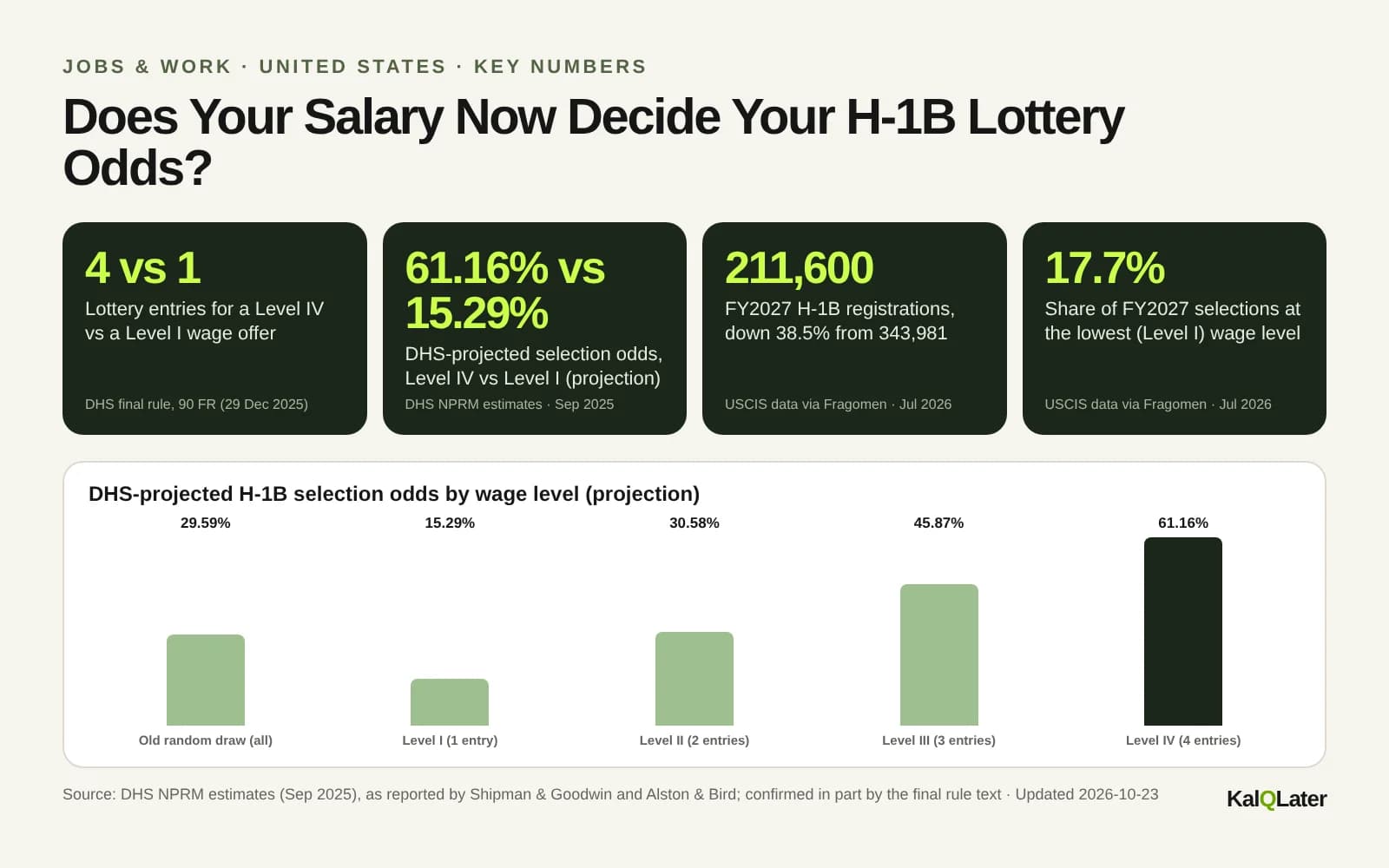
What odds did DHS project for each wage level?
DHS projected selection odds of 15.29% at Level I, 30.58% at Level II, 45.87% at Level III and 61.16% at Level IV, versus 29.59% for everyone under the old random draw. The final rule repeats that Level IV rises to "over 61 percent" and Level III to "over 45 percent".
DHS-projected H-1B selection odds by wage level (projection)
Source: DHS NPRM estimates (Sep 2025), as reported by Shipman & Goodwin and Alston & Bird; confirmed in part by the final rule textView the data
| Label | Value |
|---|---|
| Old random draw (all) | 29.59% |
| Level I (1 entry) | 15.29% |
| Level II (2 entries) | 30.58% |
| Level III (3 entries) | 45.87% |
| Level IV (4 entries) | 61.16% |
Look closely and the DHS figures are exact multiples: 15.29% times 2, 3 and 4 gives the other three. That means DHS used a straight proportional approximation (odds equal entries times a per-entry rate). It works when odds are low, but it would break above 25% per entry, because a Level IV registrant cannot exceed 100%.
Our model below uses the more precise version, where each extra entry has diminishing returns. It also uses the FY2027 pool, which was far smaller than the one DHS modelled, so every level's odds come out higher than DHS's projection.
What happened in the FY2027 H-1B lottery?
USCIS received 211,600 FY2027 registrations, 38.5% fewer than FY2026 and 72.1% below the FY2024 peak of 758,994. USCIS announced on 17 July 2026 that the cap was reached with no second lottery, but it has not published how many registrations it selected.
Eligible H-1B registrations, FY2021–FY2027
Source: USCIS H-1B Electronic Registration Process (FY2021–FY2025); Envoy Global summary of USCIS data (FY2026); USCIS figures via Fragomen and Ellis (FY2027)View the data
| Label | Value |
|---|---|
| FY2021 | 269,424 |
| FY2022 | 301,447 |
| FY2023 | 474,421 |
| FY2024 | 758,994 |
| FY2025 | 470,342 |
| FY2026 | 343,981 |
| FY2027 | 211,600 |
Registrations selected in the H-1B lottery, FY2021–FY2026
Source: USCIS H-1B Electronic Registration Process; Envoy Global summary of USCIS FY2026 dataView the data
| Label | Value |
|---|---|
| FY2021 | 124,415 |
| FY2022 | 131,924 |
| FY2023 | 127,600 |
| FY2024 | 188,400 |
| FY2025 | 135,137 |
| FY2026 | 120,141 |
USCIS always selects more than 85,000 because some selected employers never file. In FY2026 it selected 120,141 registrations covering 118,660 unique beneficiaries, a 35.3% selection rate on roughly 336,153 unique beneficiaries. Dividing selections by eligible registrations, the rate rose from 24.8% in FY2024 to 28.7% in FY2025 and 34.9% in FY2026.
What USCIS did release for FY2027 tells the weighting story. Only 17.7% of selections were at the lowest wage level, and 71.5% of selectees had a U.S. advanced degree. Penn Wharton Budget Model, simulating FY2024 data, had estimated Level I made up about 28% of selections under the old random draw, so the Level I share roughly fell by a third to a half.
Our estimate: H-1B lottery odds by wage level in an FY2027-style pool
With 211,600 registrations and 120,141 selections, we estimate odds of 24% (Level I) to 67% (Level IV) without a U.S. master's, and 42% to 88% with one. If USCIS selected only 85,000, the range falls to 16% to 50% and 26% to 70%.
We split the 211,600 FY2027 registrations by wage level using the FY2024 shares Penn Wharton Budget Model estimated from Bloomberg's FOIA data: 28.6% Level I, 39.2% Level II, 14.8% Level III and 17.4% Level IV. We then solved the weighted-lottery equation for the regular round (65/85 of selections), then the master's round (20/85) among unselected master's holders. Full arithmetic is in the methodology.
KalQLater estimated FY2027-style odds, no U.S. master's (estimate)
Source: KalQLater model using USCIS registration counts, USCIS FY2026 selections and PWBM FY2024 wage-level sharesView the data
| Label | Value |
|---|---|
| Level I | 24.1% |
| Level II | 42.3% |
| Level III | 56.2% |
| Level IV | 66.8% |
| Wage level | No U.S. master's, 120,141 selected | With U.S. master's, 120,141 selected | No U.S. master's, 85,000 selected | With U.S. master's, 85,000 selected |
|---|---|---|---|---|
| Level I (1 entry) | 24.1% | 41.6% | 15.9% | 25.9% |
| Level II (2 entries) | 42.3% | 65.9% | 29.3% | 45.0% |
| Level III (3 entries) | 56.2% | 80.1% | 40.5% | 59.3% |
| Level IV (4 entries) | 66.8% | 88.4% | 50.0% | 69.8% |
The key takeaway: a Level I registrant in FY2027 probably had better odds than a typical registrant in FY2024 (24.8% selected per eligible registration), simply because far fewer people registered. The weighting cut Level I's share, not necessarily its absolute chances. Try your own inputs in the calculator above.
Who loses and who wins under the weighted H-1B selection?
The biggest losers are Level I registrants, mostly new graduates and outsourcing-style IT roles, whose share of selections drops from about 27% to 14% in Penn Wharton's simulation. Level IV registrants gain the most, rising from about 15.5% to nearly 26% of selections.
- Level I registrants: share of selections falls from 27% to 14% (PWBM, 2021–2024 lottery simulations)
- Computer systems design firms (NAICS 5415, the outsourcing proxy): share falls 3.18 points, from 49.6% to 46.4% (PWBM)
- Indian nationals: share falls 2.14 points, from 67.6% to 65.5% (PWBM, rule alone)
- Bachelor's-only new graduates without a U.S. master's: no second draw and usually Level I or II pay
- Level IV registrants: share rises from 15.5% to almost 26% (PWBM)
- U.S. master's and PhD holders: 71.5% of FY2027 selectees, up from 57% (USCIS)
- Canadian nationals: share rises 0.90 points to 2.6% (PWBM)
- Average pay of selected workers: up $9,554 (8.5%) to $121,863 in FY2025 dollars (PWBM projection)
The country effect is smaller than many headlines suggest. Penn Wharton found the weighting alone moves India's share of selections by about 2 points, because Indian registrants are spread across all wage levels. Its August 2026 update found larger effects (India down 3.3 to 9.2 points) only when combined with the $100,000 payment, which courts have since blocked from being collected.
USCIS has published no FY2027 selections by country or employer. Treat any FY2027 country breakdown you see online as an estimate.
Could the DOL prevailing wage rule make Level I even harder?
Yes, if finalized: DOL's March 2026 proposal would lift Level I from the 17th to the 34th percentile and Level IV from the 67th to the 88th, so the same salary would map to a lower wage level and fewer lottery entries. It remained a proposal at our last check.
| Wage level | Current percentile | Proposed percentile | Lottery entries |
|---|---|---|---|
| Level I | 17th | 34th | 1 |
| Level II | 34th | 52nd | 2 |
| Level III | 50th | 70th | 3 |
| Level IV | 67th | 88th | 4 |
DOL published the proposal on 27 March 2026 and the comment period closed on 26 May 2026. We found no final rule as of 23 October 2026. Penn Wharton estimated that under the proposed thresholds, Level IV's share of a random draw would fall to 7.2%, and under weighting to 23.1% at most, because far fewer jobs would clear the top bar.
For you, this means a raise that only just clears a level today may not clear it next year. If your employer can pay comfortably above the threshold for the next level up, that margin is worth more than it used to be.
Every 2026 H-1B change and its status
As of 23 October 2026, the weighted lottery and the end of automatic EAD extensions are in effect; the $100,000 payment is extended to September 2027 but blocked by two courts; and the $103,265 fee and DOL wage rule are only proposals.
| Change | Key date | Status | What it means |
|---|---|---|---|
| Wage-weighted lottery (DHS final rule) | Effective 27 Feb 2026 | In effect | 1 to 4 entries by wage level; used for FY2027 and future caps |
| $100,000 payment (Proclamation 10973) | Effective 21 Sep 2025 | Blocked in court | Fee guidance vacated by D. Mass. on 8 Jun 2026; First Circuit denied a stay 24 Jul 2026; USCIS not collecting |
| Extension to 21 Sep 2027 (Proclamation 11069) | Signed 18 Sep 2026 | Extended on paper, blocked | N.D. Cal. vacated implementing policies 30 Sep 2026; government appealed 9 Oct 2026 |
| EO 14431 on employer layoffs | Signed 18 Sep 2026 | In effect, no guidance yet | Agencies to take layoffs into account in H-1B matters; no automatic denial |
| $103,265 cap-subject fee (DHS proposed rule) | Proposed 25 Aug 2026 | Proposed | Comments closed 24 Sep 2026; would apply to cap-subject petitions including master's cap; not final |
| DOL prevailing wage increase | Proposed 27 Mar 2026 | Proposed | Raises percentiles for all four levels; no final rule found |
| End of automatic EAD extensions | Final rule 14 Oct 2026 | In effect | No 540-day auto-extension for renewals filed on or after 30 Oct 2025, including H-4 spouses |
| DOL PERM program action | 2026 | See our explainer | Covered in our PERM freeze article |
What should you do before the FY2028 H-1B registration?
The FY2028 registration is expected in March 2027, so the next five months are the time to confirm your SOC code and wage level, and to see whether the offer can clear the next level. Each step up adds one lottery entry.
- 1Find your exact wage level
Ask your employer for the SOC code and worksite county they plan to use, then look up the four OEWS levels in DOL's Foreign Labor Certification wage data. Do not guess from national salary averages.
- 2Check the gap to the next level
If your salary is a few thousand dollars below the next threshold, ask whether the offer can be raised. Going from Level I to Level II doubles your entries.
- 3Watch for multiple registrations
If two employers register you, USCIS uses the lowest wage level among them. A second, weaker offer can lower your odds.
- 4Use the master's cap if you qualify
A U.S. master's or higher gives a second weighted draw. In our FY2027-style model it lifts Level I odds from about 24% to 42%.
- 5Plan for the fee and wage rules
If the $103,265 fee or the DOL wage rule is finalized before March 2027, the pool and wage levels could shift again. Re-run the calculator with new numbers when USCIS publishes them.
- 6Get advice for your case
Talk to an immigration attorney about cap-exempt employers, O-1 or other options if your odds are low. This article is not legal advice.
Will H-1B lottery odds rise or fall in FY2028?
Nobody can say yet: FY2028 odds depend on how many people register in March 2027, which turns on whether the $100,000 payment and $103,265 fee are in force. A smaller pool raises everyone's odds; a tighter DOL wage scale lowers the entries most people get.
Three things will decide it. First, the court cases on the $100,000 payment in the First, Ninth and D.C. Circuits. Second, whether DHS finalizes the $103,265 fee, which it estimated would raise about $8.8 billion a year on roughly 85,000 petitions. Third, whether DOL finalizes higher prevailing wages.
Also watch for USCIS to publish FY2027 selection totals. Until it does, nobody, including us, can calculate the official FY2027 odds by wage level. For the broader job market picture, see our look at remote jobs in 2026.
Claims vs evidence
“The H-1B lottery is now decided by salary.”
Selection is still random; higher OEWS wage levels get more entries (1 to 4). Wage level depends on occupation and location, not salary alone.
Partly true“Level IV workers have about a 61% chance of selection.”
That is DHS's pre-rule projection (61.16%) on a larger past pool. FY2027 odds by level were not published; our model puts Level IV at 50% to 88% depending on assumptions.
Misleading“Entry-level (Level I) workers are shut out.”
Level I was 17.7% of FY2027 selections, per USCIS. Lower share, but far from zero.
False“H-1B registrations collapsed in 2026.”
FY2027 registrations were 211,600, down 38.5% from 343,981 and 72.1% from the FY2024 peak.
True“Employers must now pay $100,000 for every new H-1B.”
The proclamation was extended to Sep 2027, but courts vacated its implementing policies and USCIS is not collecting the payment as of October 2026.
False“The weighted lottery hits Indian workers hardest.”
PWBM projected the rule alone cuts India's share of selections by about 2 points (67.6% to 65.5%); USCIS has no FY2027 country data yet.
Too earlyFrequently asked questions
How many entries does each wage level get in the H-1B lottery?
Under the DHS final rule effective 27 February 2026, a beneficiary whose offered wage meets OEWS Level IV is entered four times, Level III three times, Level II twice and Level I once. Each person is still counted once, and if several employers register the same person, USCIS uses the lowest wage level among them.
What are my H-1B lottery odds at Level I?
DHS projected 15.29% before the rule took effect. Using the smaller FY2027 pool of 211,600 registrations and 120,141 selections, our model estimates about 24% without a U.S. master's and about 42% with one. These are estimates; USCIS has not published FY2027 odds by wage level.
How many people registered for the FY2027 H-1B lottery?
USCIS reported 211,600 properly submitted registrations for FY2027, down 38.5% from 343,981 in FY2026 and down 72.1% from the FY2024 peak of 758,994. USCIS announced on 17 July 2026 that the FY2027 cap was reached and there would be no second lottery.
Does a U.S. master's degree still help in the weighted H-1B lottery?
Yes. Master's holders who miss the regular round get a second weighted draw for the 20,000 advanced-degree slots. In FY2027, 71.5% of selectees had a U.S. advanced degree, up from 57% in FY2026. In our model, a master's lifts Level I odds from about 24% to 42%.
Is the $100,000 H-1B fee still in effect?
On paper, Proclamation 11069 extended it to 21 September 2027. In practice, a Massachusetts federal court vacated the fee guidance on 8 June 2026 and a California court vacated the implementing policies on 30 September 2026, so USCIS is not collecting it as of October 2026.
What is the proposed $103,265 H-1B fee?
It is a separate DHS proposed rule published 25 August 2026 that would charge $103,265 per cap-subject H-1B petition, including master's-cap cases, on top of existing fees. Comments closed 24 September 2026. It is not final and not in effect as of 23 October 2026.
When is the FY2028 H-1B registration?
USCIS has not announced dates. Recent registrations ran in March, and FY2027's ran from 4 to 19 March 2026, so FY2028 registration is expected around March 2027. The wage-weighted selection will apply again unless the rule is changed or blocked.
How we built this analysis
- Registration series: FY2021–FY2025 eligible registrations and selections from the USCIS H-1B Electronic Registration Process page; FY2026 (343,981 eligible, 120,141 selected, 118,660 unique beneficiaries selected) from Envoy Global's summary of USCIS data; FY2027 (211,600 registrations) from USCIS figures reported by Fragomen and Ellis. Selection rate = selected registrations / eligible registrations, e.g. FY2026: 120,141 / 343,981 = 34.9%.
- Wage-level split: 211,600 x FY2024 shares from Penn Wharton Budget Model (28.6% / 39.2% / 14.8% / 17.4%) = 60,518 Level I, 82,947 Level II, 31,317 Level III, 36,818 Level IV registrants. We assume the FY2027 wage mix matches FY2024 and that each registration is one unique beneficiary.
- Weighted lottery math: for the regular round we solve for a per-entry probability p so that sum over levels of N_l x (1 - (1 - p)^w_l) = S_reg, with w = 1, 2, 3, 4 and S_reg = S x 65/85. With S = 120,141, S_reg = 91,873 and p = 0.2407, giving 24.1% / 42.3% / 56.2% / 66.8%. This approximates drawing entries without replacement until enough unique beneficiaries are picked.
- Master's round: unselected master's holders R_l = m x N_l x (1 - P1_l) enter a second weighted draw for S_adv = S x 20/85 = 28,268, solved the same way (p2 = 0.2310 with m = 62%). Odds for a master's holder = P1 + (1 - P1) x P2, e.g. Level I: 0.241 + 0.759 x 0.231 = 41.6%.
- Calibration: m = 62% is back-solved so the model's U.S. advanced-degree share of selections matches USCIS's 71.5%; with it, the model's Level I share of selections is 17.6% vs USCIS's 17.7%. Selections S = 120,141 is the FY2026 count, used because FY2027 totals are unpublished; the 85,000 scenario is a lower bound.
- DHS projections (15.29% / 30.58% / 45.87% / 61.16% vs 29.59% random) are quoted from the September 2025 proposed rule as reported by law firms; the final rule text confirms the 'just under 30', 'over 45' and 'over 61' percent figures.
Limitations
USCIS has not published FY2027 selection totals, registrations by wage level, or selection rates by wage level, country or employer, so our odds are model estimates, not official figures. We assume the FY2024 wage-level mix applies to FY2027 and that wage mix is the same for master's and non-master's registrants, which is unlikely to be exactly true. DHS's projections and Penn Wharton's simulations use earlier pools and are projections. The status of the $100,000 payment, the $103,265 fee and the DOL wage rule can change quickly with court rulings or final rules; statuses are as of 23 October 2026. This article is general information, not legal advice. Talk to a qualified immigration attorney about your situation.
Spotted an error? See our corrections policy. Read how we work in our methodology and editorial standards.
Sources
- U.S. Department of Homeland Security (Federal Register)Weighted Selection Process for Registrants and Petitioners Seeking To File Cap-Subject H-1B Petitions (final rule, 29 Dec 2025)Entries per wage level, effective date 27 Feb 2026, 'just under 30', 'over 45' and 'over 61' percent odds
- U.S. Department of Homeland Security (Federal Register)Weighted Selection Process proposed rule (24 Sep 2025)Lowest-wage-level rule, master's round weighting, cost and transfer estimates, registration history by degree
- U.S. Citizenship and Immigration ServicesH-1B Electronic Registration ProcessEligible registrations and selections FY2021–FY2025
- Envoy GlobalUSCIS Releases Data on FY 2026 H-1B Cap Selection RatesFY2026 eligible registrations, selections and unique beneficiaries (USCIS data)
- FragomenUnited States: H-1B Cap Is Reached for FY 2027FY2027 registrations 211,600, Level I share 17.7%, advanced degree share 71.5% (USCIS data)
- EllisUSCIS Reaches FY 2027 H-1B Cap: No Second LotteryFY2027 timeline: registration 4–19 Mar, selection 31 Mar, cap reached 17 Jul 2026
- Shipman & GoodwinDHS Proposes Weighted Entry System for H-1B Cap Lottery That Favors Higher Paid WorkersDHS-projected odds by wage level (15.29% to 61.16%) and 29.59% random baseline
- Penn Wharton Budget ModelProjected Effects of the New (March 2026) H-1B Visa LotterySimulated shares by wage level, nationality, industry and pay (projections)
- Penn Wharton Budget ModelThe Impact of Higher Prevailing Wages on the H-1B Visa LotteryFY2024 registration shares by OFLC wage level
- Penn Wharton Budget ModelEffects of the New $100,000 Fee and Wage-Weighted Lottery on the H-1B VisaCombined fee and weighting effects; India share; NPRM-threshold Level IV shares
- FragomenUnited States: DOL Proposes Rule to Increase PERM and H-1B Wage MinimumsCurrent vs proposed prevailing wage percentiles
- Reddy Neumann Brown PCProposed 2026 H-1B Prevailing Wage Rule: Should Employers File LCAs Now?DOL proposal published 27 Mar 2026, comments closed 26 May 2026
- F1JobsH-1B $100K Fee Update: Proclamation 11069 Extended It to 2027, So Why Isn't USCIS Collecting It?Court cases, EO 14431, $103,265 fee status (as of 13 Oct 2026)
- Cozen O'ConnorDHS Proposes New $103,265 Fee for Cap-Subject H-1B PetitionsFee scope, exemptions and $8.8 billion revenue estimate
- MintzUSCIS Final Rule Ends 540-Day Automatic EAD ExtensionFinal rule published 14 Oct 2026; affected categories